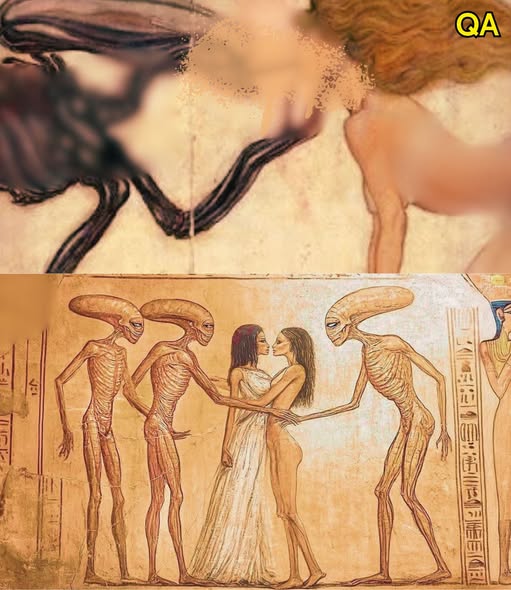
In the silent darkness of the Atacama Desert, where cold winds whispered across ancient stone ruins, the elders of the Anu tribe guarded a story older than recorded history itself. It was a legend passed from generation to generation beneath the stars — a tale claiming that long before humanity built its first cities, Earth had once been home to visitors from another world.
Some ancient texts called them “The Light Bearers.” Others named them “The Sky Walkers.” But in every version of the legend, they were described the same way: tall figures with pale silver eyes, voices that echoed directly inside the mind, and an unnatural calm that seemed almost divine. According to the oldest carvings hidden deep within the Andes Mountains, the visitors arrived during a violent age when Earth itself was still changing. Oceans raged endlessly, storms covered the skies for years, and early humans survived in scattered tribes beneath a hostile world. Then, one night, the heavens opened. A brilliant blue light descended from the stars, illuminating the desert like a second sun. Massive silent objects drifted down from the sky without fire or sound, hovering above the sands before disappearing beyond the mountains.
The ancient tribes believed gods had come to Earth. But according to the forbidden stories, they were not gods. They were survivors. Their home planet, hidden somewhere beyond the edge of known galaxies, had once been a civilization far more advanced than humanity could imagine. They had mastered energy, unlocked the secrets of gravity, and traveled across the stars through enormous gateways built in deep space. Then their world began to die. Some legends speak of a cosmic disaster. Others describe a war between civilizations so powerful it shattered entire moons. Whatever happened, only a small number escaped before their planet vanished forever into darkness. Earth became their refuge. At first, they remained hidden. Deep beneath mountains and oceans, they built vast underground cities illuminated by glowing crystal structures that replaced sunlight itself. Enormous tunnels stretched for thousands of miles beneath the planet, connecting secret chambers untouched by human eyes. Yet over time, some of them became fascinated with humanity. Unlike their own fading civilization, humans possessed something they had lost long ago: emotion, curiosity, and imagination. Slowly, the visitors began interacting with early tribes, teaching them how to study the stars, predict seasons, and construct monuments aligned perfectly with celestial movements.
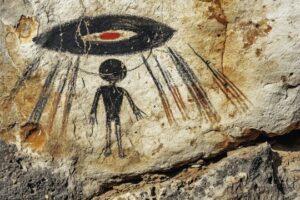
Ancient civilizations changed rapidly afterward. In Egypt, stories emerged about radiant beings descending from the heavens to share wisdom with priests and kings. In Mesopotamia, clay tablets described mysterious “sky teachers” who arrived carrying knowledge of mathematics and astronomy. Across South America, legends spoke of pale-eyed strangers appearing from the mountains before vanishing without a trace. Modern historians dismiss these stories as mythology and symbolism. But believers in the ancient legend point toward strange mysteries scattered throughout human history. Massive stone structures built with astonishing precision. Ancient astronomical maps created long before telescopes existed. Cave paintings depicting strange objects hovering in the sky beside human figures. To some, these are only coincidences. To others, they are fragments of a hidden truth. According to the Anu legend, the visitors never truly left Earth. They simply disappeared from human sight. The story claims that somewhere beneath Antarctica’s frozen ice lies the final surviving city of the ancient star travelers — a place untouched by time, powered by technology humanity still cannot understand. Strange lights occasionally reported near the polar skies are whispered to be signals from structures still operating beneath the ice. Other versions of the legend are even more unsettling. They suggest the visitors continued living among humans for thousands of years. Watching. Learning. Waiting. Some stories claim they blended into society so perfectly that nobody could recognize them. They aged slowly, concealed their origins, and quietly observed the rise and fall of civilizations across history. There are even whispers that certain extraordinary individuals throughout history may have carried traces of their bloodline — brilliant inventors, mysterious rulers, and visionaries who seemed far ahead of their time. Of course, no scientific evidence supports such claims. Most researchers explain these stories as folklore born from humanity’s fascination with the stars and the unknown. Psychologists believe ancient civilizations created sky-beings and cosmic myths to explain natural disasters, celestial events, and mysteries they could not understand. Yet the legend refuses to disappear. In the modern era, as astronomers discover thousands of distant planets and scientists search the universe for signs of life, interest in ancient extraterrestrial stories continues growing. Every unexplained signal from deep space, every mysterious object spotted in the sky, reignites humanity’s oldest question: What if we were never alone? Perhaps the most fascinating part of the legend is not whether it is true, but why humanity wants it to be true so badly. The idea that beings from distant stars once walked beside humans transforms history into something larger and more mysterious. It suggests that beneath forgotten ruins and ancient myths may lie echoes of encounters lost to time. And somewhere, hidden beneath layers of ice, stone, or ocean depths, perhaps the final remnants of those forgotten visitors still remain — silent witnesses to the civilization humanity has become. No one can prove the legend is real. No one can fully disprove it either. But on clear nights, when the stars shine brighter than the cities below, many still look toward the sky and wonder: If they once called Earth home…