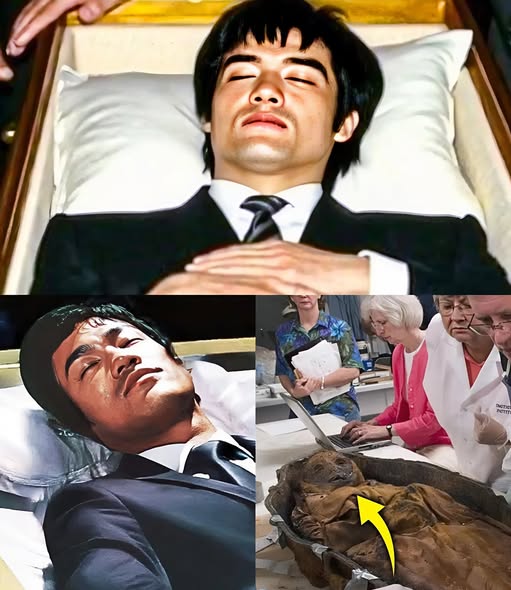
After 52 years of speculation, myths, and whispered conspiracies, the world finally confronted a reality many never imagined: Bruce Lee’s tomb has been opened. The announcement, initially treated as a cautious historical endeavor, quickly exploded into a global media storm. For over half a century, the final resting place of one of the most influential figures of the 20th century remained a near-sacred secret, fiercely protected by family and foundations alike.

But what investigators uncovered inside has left historians, martial artists, and fans in utter shock—challenging everything previously assumed about Lee’s life, philosophy, and the mysterious circumstances surrounding his untimely death.
Bruce Lee, the legendary martial artist, actor, and cultural icon, passed away on July 20, 1973, at the age of just 32. His death, sudden and unexplained by many, became a source of enduring intrigue. While official reports cited cerebral edema as the cause, rumors of foul play, poisonings, or hidden health conditions persisted for decades. Lee’s influence, however, remained undiminished. He had redefined martial arts cinema, transforming Hong Kong action films into a global phenomenon, while also challenging Western perceptions of Asian masculinity and physical capability. His philosophy of self-mastery, adaptability, and personal expression—embodied in his creation of Jeet Kune Do—resonated far beyond martial arts circles.
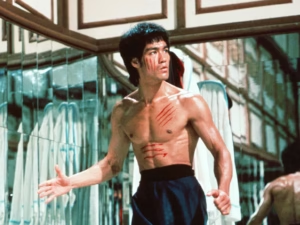
The decision to open Lee’s tomb was unprecedented. Authorized by the Bruce Lee Foundation and accompanied by a team of forensic experts, historians, and archivists, the process was framed as a scientific and cultural endeavor rather than a sensationalist stunt. “Our objective is to understand Bruce Lee as a man, not merely as a legend,” stated a representative of the foundation. “We hope modern technology can illuminate aspects of his life and work that were previously inaccessible.” The tomb, located in Seattle, had been a pilgrimage site for fans but remained inaccessible, its secrets intact—until now. Upon opening, investigators discovered remarkably well-preserved remains, along with an unexpected treasure trove of personal artifacts.
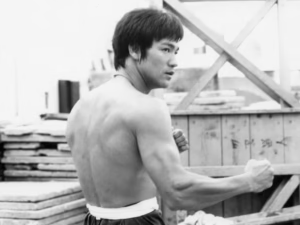
These included photographs, letters, handwritten journals, and meticulously cataloged martial arts notes. Early examinations revealed that Lee’s health at the time of death may have been compromised in ways previously unreported. Bone density analyses suggested extreme physical strain, while chemical testing indicated the presence of substances consistent with experimental herbal and nutritional supplements—reflecting Lee’s lifelong obsession with optimizing human performance. The most astonishing find, however, was a small, intricately carved wooden box hidden within the tomb’s inner chamber. Inside were detailed notebooks and diagrams describing a martial arts system never before documented. Analysts describe the contents as revolutionary, blending traditional techniques with biomechanical principles that were decades ahead of their time. The notes include precise sequences, strategic applications, and adaptive maneuvers—revealing that Lee’s mastery extended beyond physical prowess to a deep, almost scientific understanding of human movement. According to experts, the discovery may challenge modern martial arts pedagogy, potentially rewriting how techniques are taught and executed.
Beyond martial arts, the journals shed light on Lee’s philosophical explorations and personal reflections. In passages marked by introspection, Lee delved into human potential, ethics, and the nature of conflict, suggesting a sophisticated framework that transcended physical combat. His writings reveal a man acutely aware of mortality and legacy, wrestling with questions that remain remarkably relevant today: How does one balance physical mastery with moral integrity? How can knowledge and innovation serve humanity without compromising one’s own identity? These documents paint a portrait of a thinker as meticulous and forward-looking as he was a fighter. The revelation has profound cultural implications. For decades, Bruce Lee has been mythologized, his life filtered through the lens of cinema, merchandise, and media portrayals. Biopics and documentaries often emphasized spectacle—high kicks, cinematic fights, and personal charisma—while sidelining the philosophical and intellectual rigor behind his persona. Now, with access to these private writings, historians have an unprecedented opportunity to reconstruct an authentic understanding of Lee’s life and influence. His philosophies on adaptability, self-expression, and integration of knowledge are not merely theoretical—they were documented, practiced, and systematized with precision. The opening of the tomb also ignited debates among medical experts and forensic historians. While Lee’s death has long been attributed to cerebral edema, the forensic data collected from his remains suggest a more nuanced scenario. Anomalies in bone and tissue structure, coupled with traces of experimental supplements, indicate that his death may have been a complex interplay of genetic factors, extreme physical conditioning, and possibly undiagnosed medical conditions. This insight offers not only clarity but a sobering reminder of the risks associated with extreme physical dedication—an aspect of Lee’s life that has been romanticized in popular culture but now warrants scientific scrutiny.